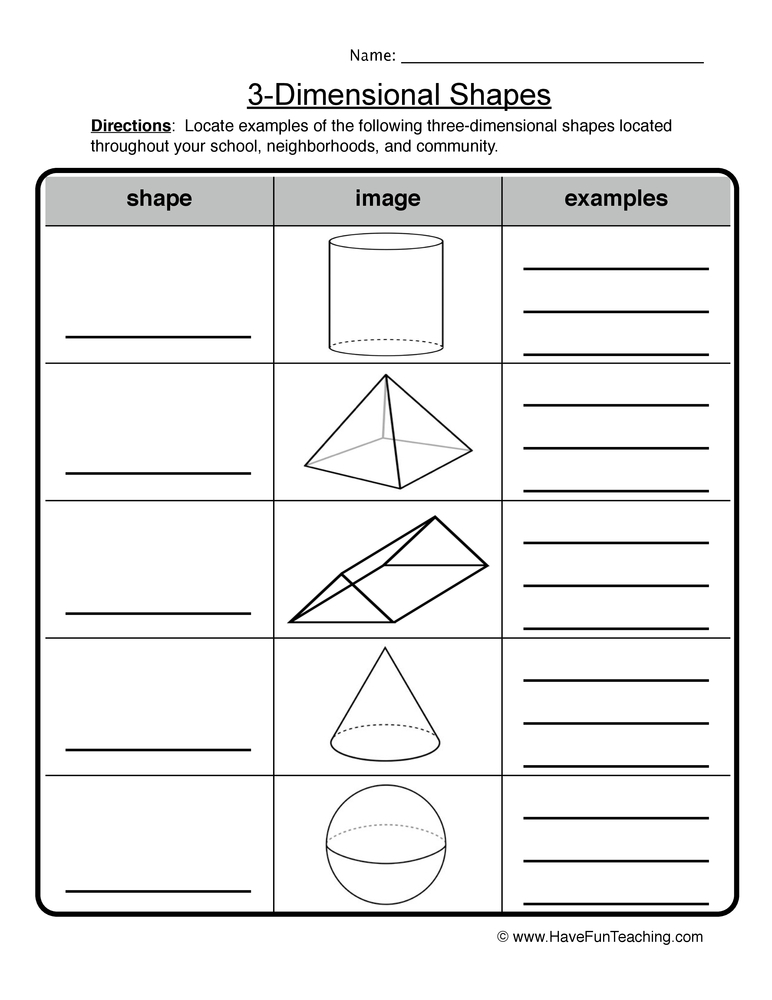
Three-dimensional (3D) shapes are shapes that have three dimensions – length, width, and height. These shapes are often referred to as solid shapes and can be found all around us in the real world. Teaching students about 3D shapes is an important part of their mathematical development, as it helps them understand spatial relationships and geometry.
One effective way to help students learn about 3D shapes is by using worksheets. These worksheets can provide practice with identifying and naming different 3D shapes, as well as exploring their properties such as faces, vertices, and edges. They can also help students learn how to visualize and manipulate these shapes in their minds.
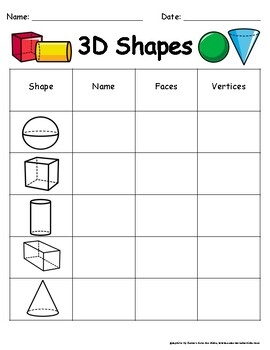 Three D Shapes Worksheets
Types of Worksheets:
1. Identifying 3D Shapes: These worksheets typically involve showing students pictures of different 3D shapes and asking them to identify and name each shape. This helps students become familiar with the various types of 3D shapes, such as cubes, spheres, cylinders, cones, and pyramids.
2. Counting Faces, Vertices, and Edges: These worksheets require students to count the number of faces, vertices, and edges on different 3D shapes. By doing this, students can start to understand the unique characteristics of each shape and how they differ from one another.
3. Sorting Shapes: In these worksheets, students are asked to sort a group of 3D shapes into different categories based on their properties. This helps students develop their classification skills and understand how shapes can be grouped together based on shared characteristics.
Using 3D shapes worksheets can make learning about geometry fun and engaging for students. They provide a hands-on way for students to practice their spatial reasoning skills and develop a deeper understanding of the properties of 3D shapes. By incorporating worksheets into their lessons, teachers can help students build a strong foundation in geometry that will benefit them in their future mathematical studies.
In conclusion, Three D Shapes Worksheets are a valuable tool for teaching students about 3D shapes and helping them develop their spatial reasoning skills. By providing practice with identifying, counting, and sorting 3D shapes, these worksheets can enhance students’ understanding of geometry and prepare them for more advanced mathematical concepts. Incorporating worksheets into lessons can make learning about 3D shapes both educational and enjoyable for students.