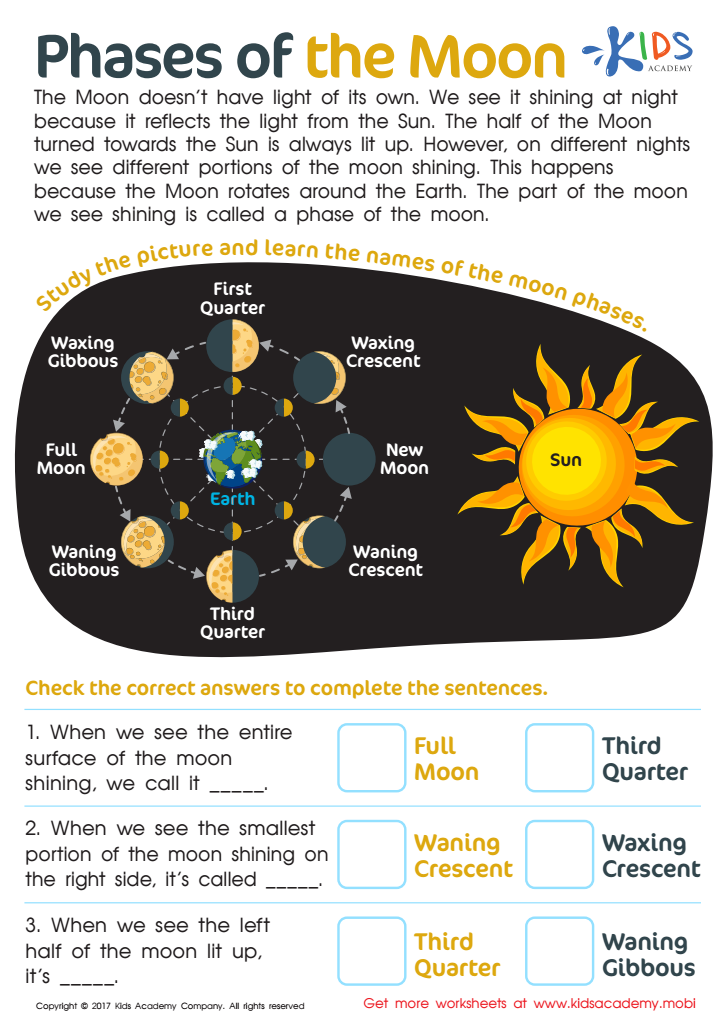
One of the most fascinating phenomena in our sky is the changing phases of the moon. As the moon orbits around the Earth, different portions of its illuminated surface are visible to us. This cycle of changing shapes, known as the lunar phases, is a great opportunity for students to learn about the relationship between the Earth, the moon, and the sun.
There are eight main phases of the moon: new moon, waxing crescent, first quarter, waxing gibbous, full moon, waning gibbous, third quarter, and waning crescent. Understanding these phases and their sequence can be challenging for students, which is why a phases of the moon worksheet can be a useful tool for learning.
 Phases Of The Moon Worksheet
Phases Of The Moon Worksheet
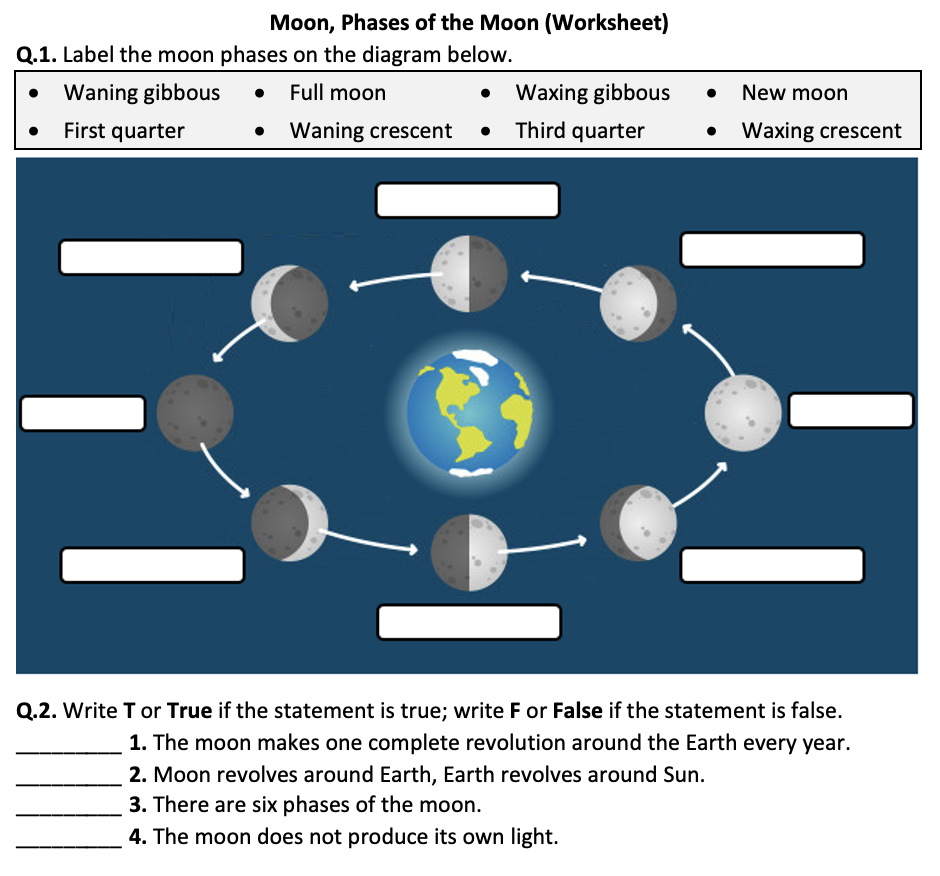
A phases of the moon worksheet typically includes diagrams of the moon in different phases, along with spaces for students to label each phase and write a brief description. This hands-on activity allows students to visualize the changes in the moon’s appearance throughout its cycle and understand the position of the moon in relation to the sun and Earth.
Students can also use the worksheet to track the moon’s phases over a period of time, observing how the moon transitions from one phase to the next. This can help them grasp the concept of the lunar cycle and how the moon’s position relative to the sun causes its changing appearance in the sky.
By completing a phases of the moon worksheet, students can deepen their understanding of astronomy and the natural world around them. This activity can also spark curiosity and interest in space science, leading to further exploration and learning about the universe.
In conclusion, a phases of the moon worksheet is a valuable educational tool for teaching students about the lunar phases and the relationship between the Earth, moon, and sun. By engaging in hands-on activities like this, students can enhance their understanding of astronomy and develop a greater appreciation for the wonders of the night sky.