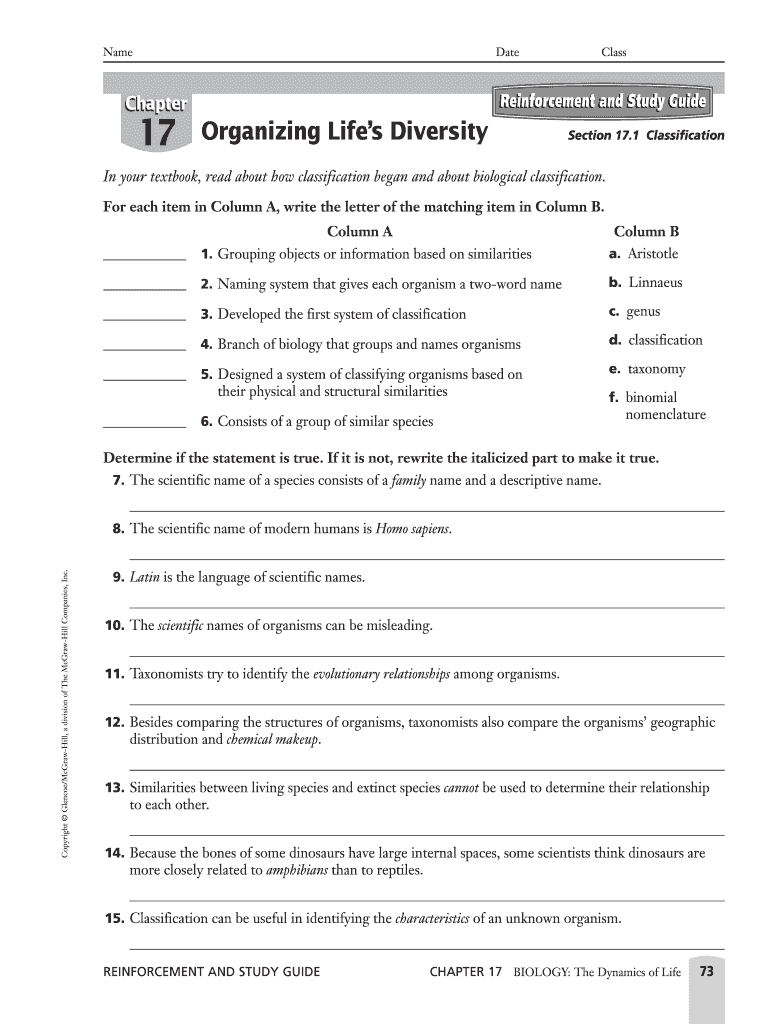
Chapter 8 of Biology: The Dynamics of Life covers a wide range of topics related to the study of living organisms and their interactions with each other and the environment. This chapter delves into the dynamics of populations, communities, and ecosystems, exploring concepts such as population growth, carrying capacity, and biodiversity. To reinforce the concepts learned in this chapter, students are often given worksheets to complete that test their understanding of the material.
These worksheets are designed to help students review and apply the information covered in Chapter 8. They may include questions on topics such as ecological relationships, food webs, and energy flow in ecosystems. By completing these worksheets, students can reinforce their knowledge and improve their understanding of the complex dynamics of life on Earth.
 Chapter 8 Biology The Dynamics Of Life Worksheet Answers
Worksheet Answers
1. Population growth refers to the increase in the number of individuals in a population over time. It can be influenced by factors such as birth rate, death rate, immigration, and emigration. Population growth can be exponential, logistic, or cyclic, depending on the resources available and other environmental factors.
2. Carrying capacity is the maximum number of individuals that a habitat can support sustainably. When a population exceeds its carrying capacity, resources become limited, leading to competition, decreased reproduction, and possibly population decline. Understanding carrying capacity is crucial for managing and conserving wildlife populations.
3. Biodiversity is the variety of different species of plants, animals, and microorganisms in an ecosystem. High biodiversity is important for ecosystem stability and resilience, as it provides more opportunities for species to adapt to changing conditions. Loss of biodiversity can have detrimental effects on ecosystem health and function.
4. Food webs are complex networks of feeding relationships in an ecosystem, illustrating the flow of energy and nutrients from producers to consumers to decomposers. Each organism in a food web plays a specific role in the transfer of energy through the ecosystem, highlighting the interconnectedness of all living things.
5. Energy flow in ecosystems follows the laws of thermodynamics, with energy being transferred from one trophic level to another. As energy moves through the food chain, it is lost as heat, limiting the efficiency of energy transfer. Understanding energy flow is essential for predicting the effects of disturbances on ecosystem dynamics.
In conclusion, Chapter 8 of Biology: The Dynamics of Life provides valuable insights into the intricate dynamics of living systems on Earth. By completing worksheets that test their understanding of key concepts such as population growth, carrying capacity, biodiversity, food webs, and energy flow, students can enhance their knowledge and appreciation of the complexity of life in all its forms.