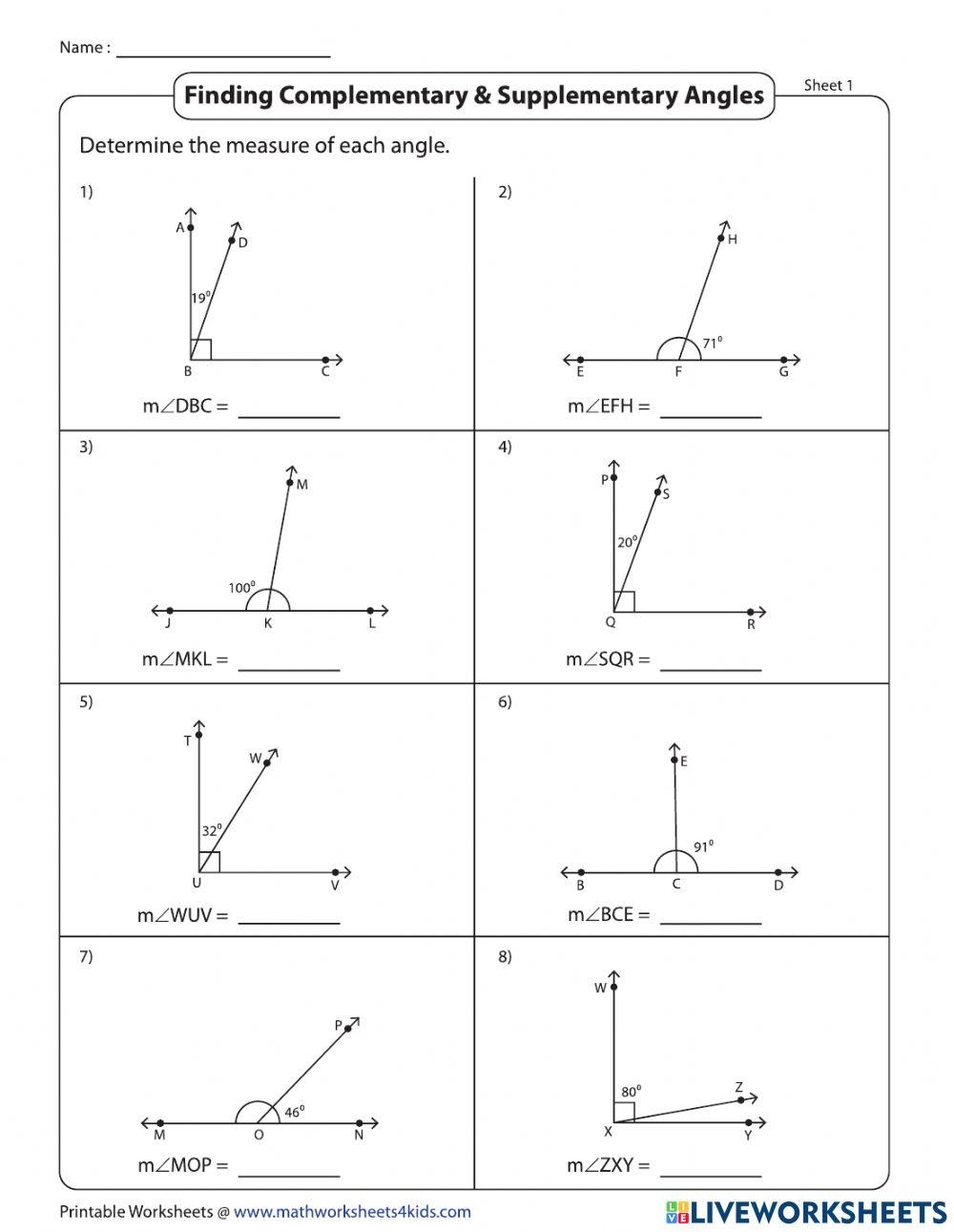
Complementary and supplementary angles are important concepts in geometry that help us understand the relationship between angles. Complementary angles add up to 90 degrees, while supplementary angles add up to 180 degrees. These concepts are crucial in solving various geometry problems and can be practiced through worksheets to strengthen understanding.
Worksheets on complementary and supplementary angles provide students with the opportunity to practice identifying and calculating these angles. By working through different problems and scenarios, students can improve their skills in recognizing these types of angles and applying the relevant formulas to find their measures. This hands-on practice is essential for mastering the concept of complementary and supplementary angles.
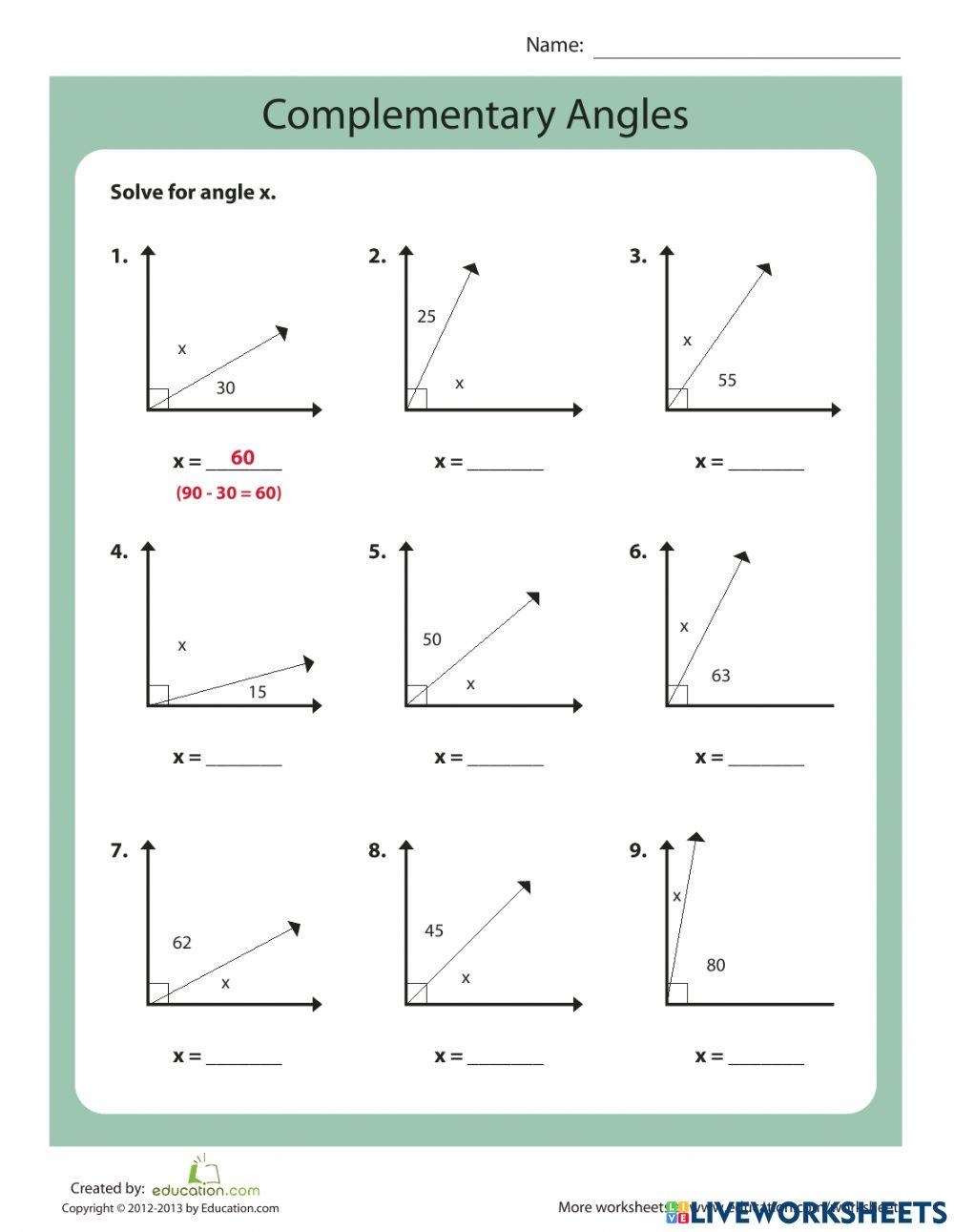 Worksheet Complementary And Supplementary Angles
One common type of question found in these worksheets is to identify whether a pair of angles is complementary or supplementary based on their measures. Students need to remember that complementary angles have a sum of 90 degrees, while supplementary angles have a sum of 180 degrees. By determining the relationship between the given angles, students can correctly classify them and proceed with solving the problem.
Another type of question in these worksheets involves finding the measure of one angle when given its complementary or supplementary angle. This requires students to understand how to set up and solve equations based on the properties of complementary and supplementary angles. Through practice, students can enhance their problem-solving skills and become more proficient in handling such problems.
Worksheets on complementary and supplementary angles can also include real-world scenarios where students need to apply the concept to solve practical problems. By connecting the concept to real-life situations, students can see the relevance and importance of understanding complementary and supplementary angles in various contexts. This type of application-based learning can deepen students’ understanding and appreciation of the topic.
In conclusion, worksheets on complementary and supplementary angles are valuable tools for students to practice and reinforce their understanding of these important geometric concepts. By engaging with different types of problems and scenarios, students can enhance their skills in identifying, calculating, and applying complementary and supplementary angles. Through consistent practice and application, students can build a strong foundation in geometry and develop problem-solving abilities that will benefit them in various mathematical contexts.