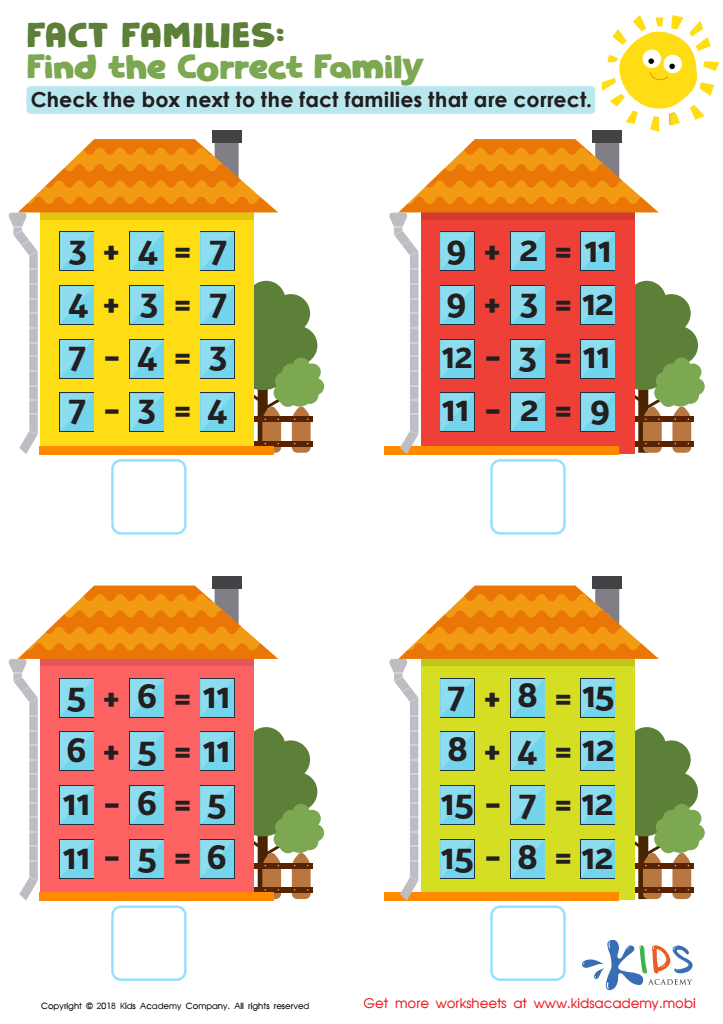
Fact families are a crucial concept in elementary math that help students understand the relationships between addition and subtraction. A fact family consists of three numbers that are related through addition and subtraction. By practicing with fact families, students can develop their understanding of basic math operations and improve their number sense.
One effective way to practice fact families is through the use of worksheets. Fact families worksheets provide students with a structured format to practice addition and subtraction relationships. These worksheets typically include a set of numbers that students must use to create addition and subtraction facts within a specific number range.
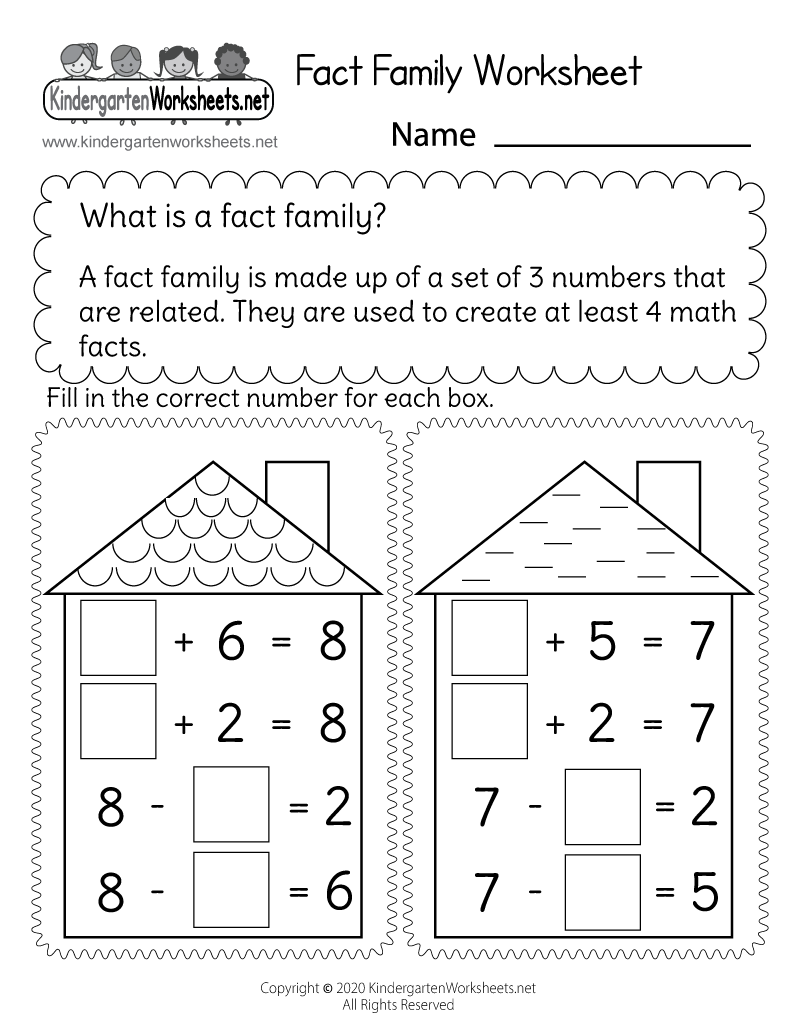 Fact Families Worksheet
When completing fact families worksheets, students are encouraged to identify the three numbers that make up the fact family and then write out the corresponding addition and subtraction facts. For example, if the numbers 3, 4, and 7 are given, students would write out the addition facts 3 + 4 = 7, 4 + 3 = 7, and the subtraction facts 7 – 4 = 3, 7 – 3 = 4.
By practicing with fact families worksheets, students can improve their fluency in basic math operations and develop their problem-solving skills. These worksheets can be used in the classroom as part of a math lesson or as homework assignments for students to practice independently. Teachers can also use fact families worksheets as a formative assessment tool to gauge student understanding of addition and subtraction relationships.
Overall, fact families worksheets are a valuable resource for helping students master basic math concepts and build a strong foundation in arithmetic. By providing students with opportunities to practice with fact families, educators can support their development of mathematical fluency and problem-solving abilities.
Whether used in the classroom or at home, fact families worksheets are a versatile tool for reinforcing key math skills and promoting a deeper understanding of addition and subtraction. By incorporating these worksheets into math instruction, educators can help students build confidence in their math abilities and prepare them for more complex mathematical concepts in the future.