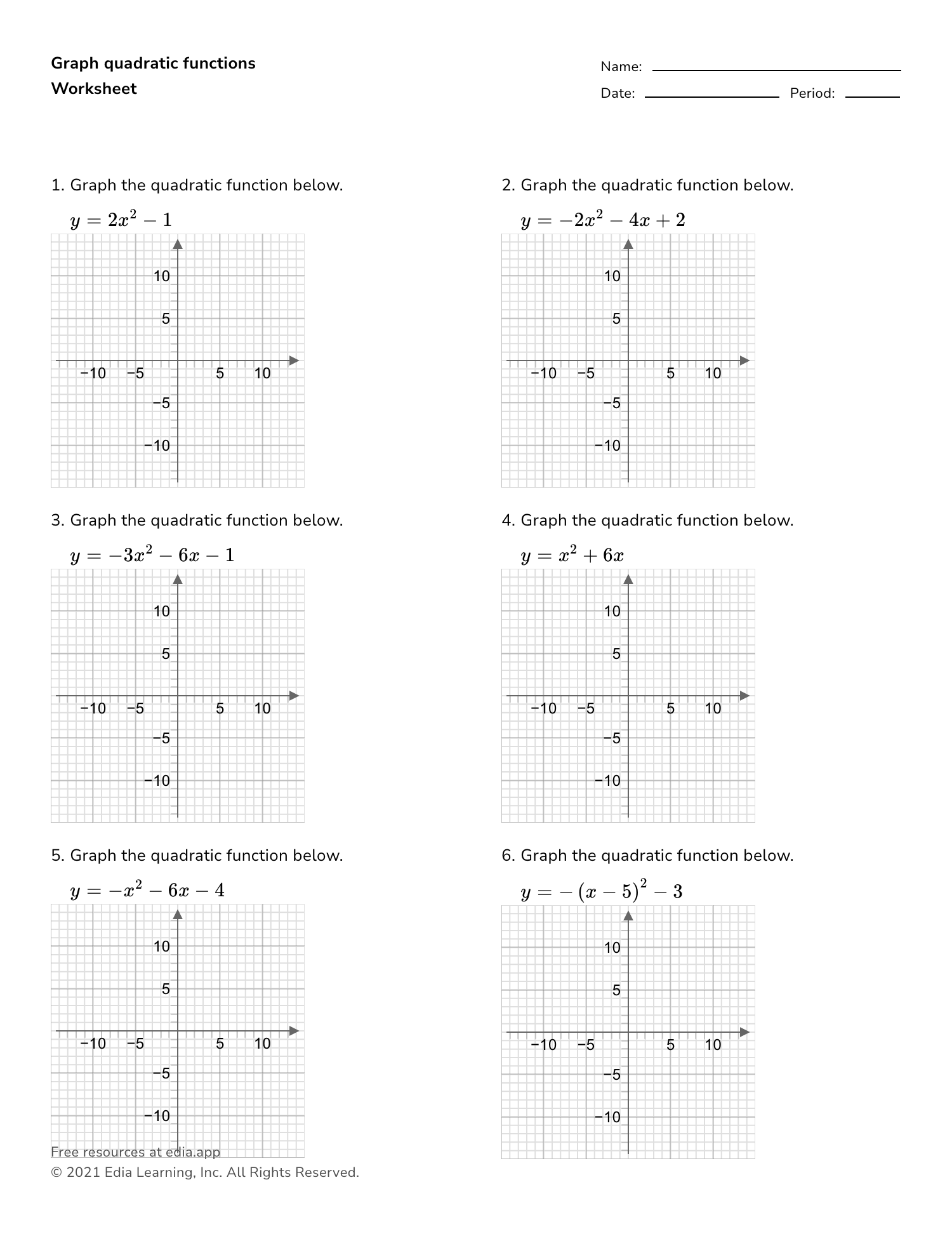
Graphing quadratic functions is an essential skill in algebra and calculus. It helps us visualize the behavior of these functions and understand how they interact with the coordinate plane. One common way to practice graphing quadratic functions is through worksheets.
Quadratic function worksheets typically involve tasks such as graphing a given quadratic function, identifying key features like the vertex and axis of symmetry, and determining the domain and range of the function. These worksheets are a valuable tool for students to hone their graphing skills and deepen their understanding of quadratic functions.
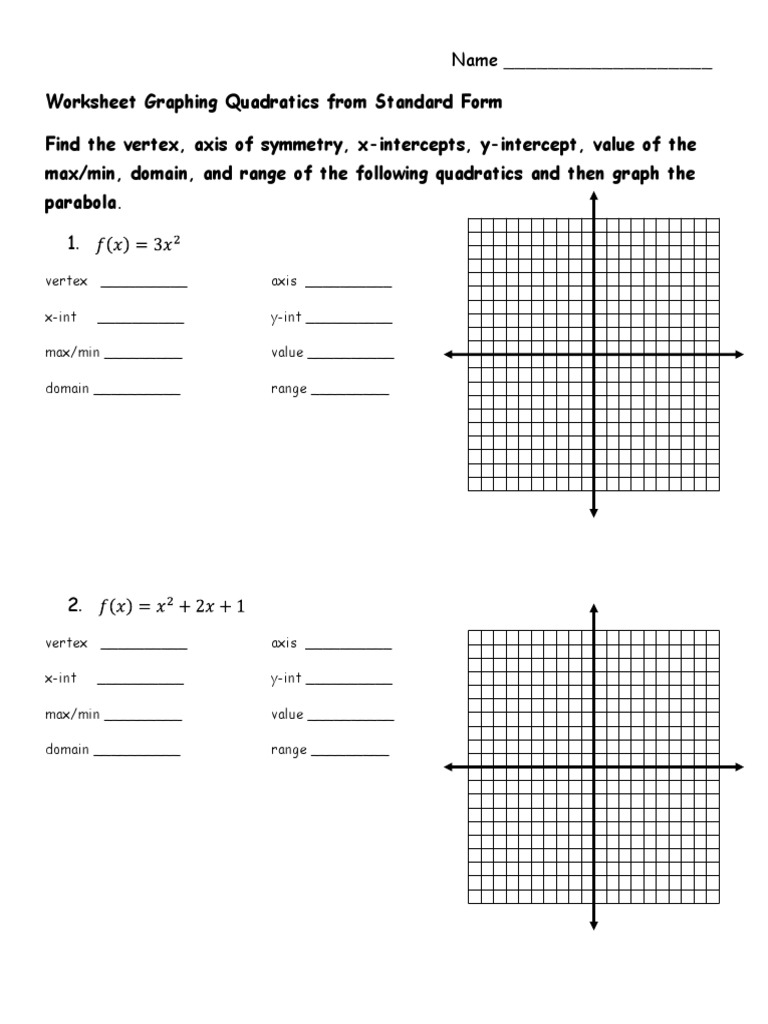 Graphing A Quadratic Function Worksheet
When graphing a quadratic function, it is important to remember the general form of a quadratic function: f(x) = ax^2 + bx + c. The coefficient ‘a’ determines the direction of the graph (upward or downward), while the vertex of the parabola is located at the point (-b/2a, f(-b/2a)). By plugging in different values of x, students can plot points on the graph and connect them to create a smooth curve.
Quadratic function worksheets may also include word problems that require students to interpret real-life situations and model them using quadratic functions. These problems help students see the practical applications of quadratic functions and develop problem-solving skills. By working through these worksheets, students can improve their graphing abilities and gain a deeper appreciation for the beauty of quadratic functions.
One common challenge students face when graphing quadratic functions is determining the direction of the graph based on the coefficient ‘a’. If ‘a’ is positive, the parabola opens upwards, while if ‘a’ is negative, the parabola opens downwards. Students should also pay attention to the vertex and axis of symmetry, as these points provide valuable information about the function’s behavior.
In conclusion, graphing quadratic functions through worksheets is a valuable exercise for students to practice their graphing skills and deepen their understanding of quadratic functions. By working through problems that involve graphing, identifying key features, and solving word problems, students can improve their mathematical proficiency and gain confidence in handling quadratic functions.